
Learning Session 15: Wildlife Tracking for Connection
Online learning sessions using dialogue to explore the workings, developments, (im)possibilities, and emerging insights of diverse approaches and praxes for Co-creation with the More-than-Human world
The 15th learning session of the Co-creation with the More-than-Human sandbox explored Wildlife Tracking for Connection with Jon Young, a deep nature-people-self connection researcher, mentor, naturalist, wildlife tracker, author, consultant, and storyteller.
Initiated into traditional tracking skills at the age of ten, Jon went on to study tracking cultures across the world, seeking to understand how this ancient way of perception shapes people and communities. Mentored by elders including Tom Brown Jr., Jon has spent over 40 years walking this path. He is the author and co-author of seminal works such as What the Robin Knows and Coyote's Guide to Connecting to Nature, and has appeared in documentaries including The Animal Communicator. In 2016, he received the Champion of Environmental Education Award for his global impact.
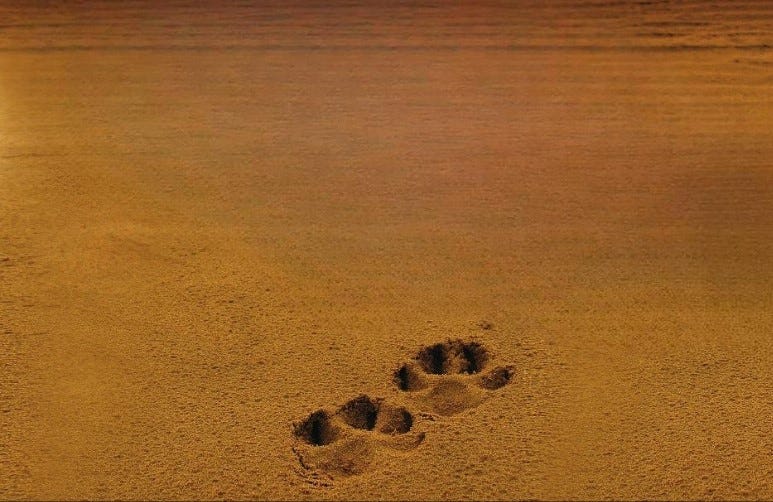
The session examined what holistic tracking actually is beneath the footprint-in-the-mud image, what it cultivates in the people who practice it, and what it might offer a world that has largely lost access to it.
What follows is a synthesis of key questions, insights, and cross-cutting threads from the dialogue.
🎧 Prefer listening? Open the link in the Substack app and tap Play, or paste it into e.g. Paper2Audio (a free text-to-speech player) to turn it into an audio version
🌿 Learning Session 15 — Synthesis Wildlife Tracking for Connection, with Jon Young
What if tracking's real power isn't in the answers it gives you, but in how much sharper the questions get every time you ask them?
1. The story a tracker brings back to the fire
Six questions, and they get sharper with every year
Jon opens up holistic tracking with the same six questions a journalist asks: who left the track, what they were doing, when they passed, where they are now, why they moved the way they did, and how they moved — their mindset, their intent.
None of these stay static. Who keeps deepening: not just a coyote, but a particular female you’d recognize by her gait, until she has a name. Why always sends you back to the landscape rather than the animal — why this edge and not that one, why this stretch of forest and not the next. And how is almost an emotional register: a bobcat licking itself doesn’t trigger bird alarms; a bobcat moving furtively does, because the birds are reading its intent, not just its presence.
Two more practices to round out the eight arts
Jon adds two more practices to round it out into what he calls the eight arts. Imitation: trackers physically re-enact what they’re reading — hands, body, face — as they walk, and again later as they tell the story back home, which pulls in far more of the nervous system than watching alone ever could.
And interoception: paying attention to your own felt sense while you track — the sudden tension you feel crossing an otherwise peaceful glade, which turns out to be a hawk sitting silent in the canopy, sensed through the hush of the songbirds before you ever see it.
Where the questions came from
None of this is arbitrary. Jon describes children of the San people in southern Africa coming home from the bush each evening to be grilled by aunties, uncles, and grandparents with exactly this set of questions — who, what, when, where, why, how — the same structure, he points out, that underlies journalism and storytelling everywhere. It’s how a culture keeps pulling its children’s attention outward, generation after generation.
🌱 Seed:
The last two arts — empathy, interoception — is what turns tracking from a technical skill into a relational one. It’s the moment a tracker’s own body becomes an instrument for reading the landscape, not just a recorder of it.
2. Hardwired, then unlearned, then re-taught by not being taught
Born to it
Jon doesn’t treat tracking as a specialized skill — he treats it as a human default, something our ancestors practiced collectively for roughly 290,000 years, hardwired in by sheer duration. At root, tracking just means using your senses to make sense of the world — including the everyday business of finding your way to a Zoom call.
Coyote teaching
The method that unlocked this in him came from Tom Brown Jr., himself mentored for over a decade by an Apache elder — and it never answers a question directly. It only ever returns a better one, rooted in a specific cultural lineage of awareness. As a ten-year-old sent to sit in the same forest spot daily, first for twenty minutes and eventually for an hour, Jon would get quizzed every night on what he’d noticed. A pattern of bird alarms moving in a line, tracked over three years, eventually led him to map an entire fox’s territory — den, scat trail, mate, pups — not because his mentor handed him the answers, but because Tom kept asking what the animal must have been doing to produce what Jon had just described.
What it builds
Jon says people raised inside this kind of mentoring end up carrying a distinct capacity — holding several frameworks of information at once, moving fluidly between them. He saw this in himself at university, where professors remarked on his ability to code-switch between physics, anthropology, and natural history, without him even realizing that wasn’t how everyone’s mind worked.
🌱 Seed:
The mentoring method matters as much as the content. A lineage that refuses to answer and only asks better questions is what builds the perceptual capacity — not information transfer, but a slow training of attention.
3. Ropes of connection: what reciprocity is made of
Thread, string, cord, rope
Jon tells the story of an elder named Xanama [Hanama], from the San of the central Kalahari in western Botswana, who laid out a specific sequence: the first encounter with any being — plant or animal, it makes no difference — is reciprocal from the start, being seen as much as seeing. That moment forms a thread. As the relationship deepens, the thread becomes a string, then a cord, then a rope — and energy runs both ways along it, the same way a beloved pet seems to sense things about its person that were never signalled out loud.
What the rope is made of
Jon asked Xanama directly what the ropes were made of. Xanama didn’t hesitate: love. And he wasn’t describing a handful of pets — he was describing four or five hundred species across his landscape, all held in relationship this way. Jon’s read on it is blunt: you can’t build a relationship with something and not love it.
It runs both ways
This isn’t just felt — it shows up as changed animal behavior. Following a kudu’s tracks in the Kalahari, there’s a recognizable moment when the animal tenses and starts moving in a dead-straight line toward cover. San trackers read that as the moment the kudu feels itself being tracked — often well before it ever comes into view.
🌱 Seed:
Reciprocity here isn’t a metaphor for care — it’s a literal, felt, two-way channel that thickens with attention over time, built the same way with a fox, a coyote, or a beloved dog as with four hundred other species sharing one landscape.
4. What a landscape tells you before it burns
From animal to ecosystem
The same perceptual muscle Jon used to find a single wolf across two million acres of Idaho wilderness — by tracking the prey behavior it disturbed rather than the wolf itself — scales up to reading a whole landscape’s health and direction of travel. Phil Tovey, of ASRA (the Accelerator for Systemic Risk Assessment), asked Jon directly whether tracking could feed into systemic risk response — learning to read the risk in a shared landscape differently.
A wildfire the trackers saw coming
In the fire-prone bioregion where Jon now lives, he says his tracker friends predicted a wildfire disaster well before it hit — a fire that ultimately destroyed 900 houses and killed one person — reading warning signs in the landscape that the people making land-management decisions missed entirely. He’s now part of a planned partnership with a local tribe to bring back cultural burning, on one condition tribal elders insisted on: everyone tending the land has to first learn to see it through a tracker’s eyes. Otherwise, Jon says, they won’t notice the bird nests, and they won’t have the nuance of the whole ecology needed to make good decisions.
What it does for people, not just landscapes
Two young people Jon brought into this fire-remediation work through tracking and bird language went, he says, from feeling like outsiders in nature — like aliens who didn’t belong — to feeling like part of a family they could help take care of. He describes that shift as common, almost predictable, among people encountering holistic tracking for the first time.
🌱 Seed:
Reading a landscape’s risk may be less about new instruments and more about recovering an old form of attention — one that, in Jon’s telling, gave advance warning long before the outcome became irreversible.
5. The oldest language, and why technology doesn’t compete with it
Older than speech
Jon borrows a line from filmmaker and author Craig Foster: tracking may be the oldest human language there is, older than speech itself. Speaking it today, Jon says, means operating in a register almost nobody around you shares anymore.
Coexistence, not competition
One might expect technology to be the enemy here, but it’s the opposite — teaching tracking has actually gotten easier over the past twenty years because of it. Zoom lets students bring photographs and stories without traveling anywhere; WhatsApp carries the daily “story of the day” exchange that once needed physical presence. But Jon is careful to draw a line: this is an efficiency layer, not a substitute. Dirt time — actual sensory immersion in a landscape — stays non-negotiable. Tracking starts in the mind, but it has to move into the body, eventually into “every cell and the marrow of your very bones.”
🌱 Seed:
Ancient tracking and modern tools can be held as dance partners rather than rivals — technology can carry a relationship between sessions, but it can’t manufacture the embodied, sensory time the relationship is actually built from.
6. Tracking as data — and why the trackers out-produced the scientists
A direct comparison
As an example, Jon tells the story of Louis Liebenberg, who built the CyberTracker system after decades working alongside the San people, and who once ran a direct comparison: scientists studying antelope with airplanes, radio telemetry, and tranquilizer darts, against a small group of San trackers armed with the CyberTracker app, covering the same landscape over the same stretch of time. The San team cost a fraction as much — no crew to feed or fly in — and, in Jon’s telling, gathered dramatically more data: not just on the target species, but on birds, plants, insects, and a moth hatch nobody had recorded before, simply because their curiosity wasn’t boxed into a single research question.
Teaching the teachers
The scientists on that project even had to be taught by San trackers how to recognize the track and signs of the animal they were supposedly the experts on.
Where the real tension sits
A participant working in conservation storytelling in Uganda pushed on this: the indigenous trackers he works with keep emphasizing relationship with a landscape over simply extracting data from it. Jon doesn’t hear that as a conflict — he points to CyberTracker International as proof it’s already a working marriage, pairing indigenous tracking knowledge with formal science rather than pitting them against each other.
🌱 Seed:
The choice was never between relational tracking and rigorous data. In Jon’s account, the most relational trackers produced the richest data — curiosity and care made the observation better, not looser.
7. Becoming legible to what you’re tracking
Old lore, still alive
Jon points to regional folklore that echoes what trackers describe feeling directly. In some traditions, stepping on a grizzly's track is said to insult the bear, and it will come looking for whoever did it. In others, from indigenous communities of the northeast, looking straight at a bear's track is said to make the bear sense it and turn to watch you back.
Uncle Buck
Jon offers his own example. A three-legged buck he calls Uncle Buck, hit by a car years ago and ever since protected by the younger deer he’d mentored, went briefly unaccounted for one morning after Jon heard coyotes making the calls that mean a kill. Minutes after the fear hit him, Uncle Buck came walking up the driveway, unharmed, and just stood there looking at him. Jon doesn’t call that a coincidence — he says it’s happened too many times, across too many years, to be one.
🌱 Seed:
Tracking, in Jon’s telling, is never one-directional. At some threshold of relationship, the tracker is also being tracked — and the animal knows it.
8. Where to begin
A field guide and an uncomfortable question
Jon’s concrete advice for anyone starting out: get a field guide for your bioregion, list every mammal on the range map, and ask yourself honestly whether you could prove any of them are actually there. Most will be nocturnal or shy — and because every mammal that’s survived has had to learn bird language or die, they already know you’re coming, often minutes before you arrive.
One sentence to sit with
The practice Jon recommends needs no mentor at all: pick one sit-spot, go there daily even for ten or fifteen minutes, and carry one question with you — what are the birds saying about me?
What are the birds saying about me? He calls birds the most generous teachers there are, asking nothing but your repeated presence — and promises a side effect of taking bird language seriously, which is that the mind goes quiet.
🌱 Seed:
The entry point to holistic tracking doesn’t need wilderness, expertise, or a mentor — just one fixed spot, returned to daily, and the discipline of asking what the birds already know.
Cross-cutting insight threads
Perception as the whole practice
Every thread in this session — wolf census work, wildfire prediction, San data collection — traces back to the same root: tracking is a discipline of attention, not a checklist of skills. The eight arts read less like a technique and more like a description of what fuller attention looks like once it’s cultivated deliberately, over years.
Relationship outperforms extraction
The CyberTracker comparison is the sharpest evidence for a claim running through the whole dialogue: care and relationship don’t compete with rigor, they produce it. The most relationally engaged trackers gathered the richest, cheapest, most reliable data — not despite their intimacy with the landscape, but because of it.
Mentoring by question, not answer
Coyote teaching — never answering directly, always returning a better question — is the transmission mechanism underneath everything else in this session, from a ten-year-old learning to read fox signs to the adults Jon now mentors into the next generation of trackers worldwide.
Landscapes that speak, if you’re listening
The line connecting individual animal tracking to wildfire prediction and systemic risk work is one claim: landscapes are telling their own story continuously, in real time, to anyone trained to notice — and the cost of not noticing shows up in outcomes like 900 lost houses.
Reciprocity as a literal channel
Jon's image of the rope keeps returning across the session: a bond that starts as a thread, thickens into a string, then a cord, then a rope — all of it, in Xanama's words, made of love. It shows up again and again as something felt and demonstrated: the buck, the coyote, and the everyday version many of us already know — someone suddenly announcing "my cat is hungry" with no visible signal at all, and the cat comes running by the time the food bag is reached for.
None of this is poetic language draped over one-directional observation. In Jon's telling, it's simply how attention travels once a relationship has been given enough time to grow a rope strong enough to carry it both ways.
Jon currently leads Living Connection 1st, where he and Sarah Fontaine are working together with an international network of nature-connection organizations to help sustain deep nature-connection mentoring, including tracking, worldwide. Visit the Living Connection 1st Resources Page to explore free and low cost offerings to deepen nature and people connection, and to join the mailing list.
Jon is also the author and co-author of seminal works such as What the Robin Knows and Coyote’s Guide to Connecting to Nature. Sarah Fontaine, who co-teaches tracking with Jon, offers her own Wildlife Tracking for Connection course at sarahfontaine.com.
Closing
These sessions are not designed to arrive at fixed answers, but to surface how different approaches work in practice. Each conversation reveals not only how and where they hold, but also the tensions and questions that remain unresolved—and that continue to invite further inquiry.
Over time, these syntheses form a growing body of insights into what co-creation with the more-than-human world might require, across contexts and practices.
The Co-creation with the More-than-Human sandbox is a collaboration between The Repatterning Collective and Kincentric Leadership.
If you’d like to receive announcements of our popular monthly online learning sessions, which use live dialogue & discussion to explore different approaches and praxes for meaningful co-creation with the more-than-human (natural) world, then register here for the sandbox’s mailing list.
To receive syntheses of Learning Sessions and Field Dialogues in your inbox, subscribe below.
We donate our time and energy to this sandbox. If you value this space, consider co-funding this work by leaving us a tip.