
Learning session 13: Catalysing Nature-Centrism
Online learning sessions using dialogue to explore the workings, developments, (im)possibilities, and emerging insights of diverse approaches and praxes for Co-creation with the More-than-Human world
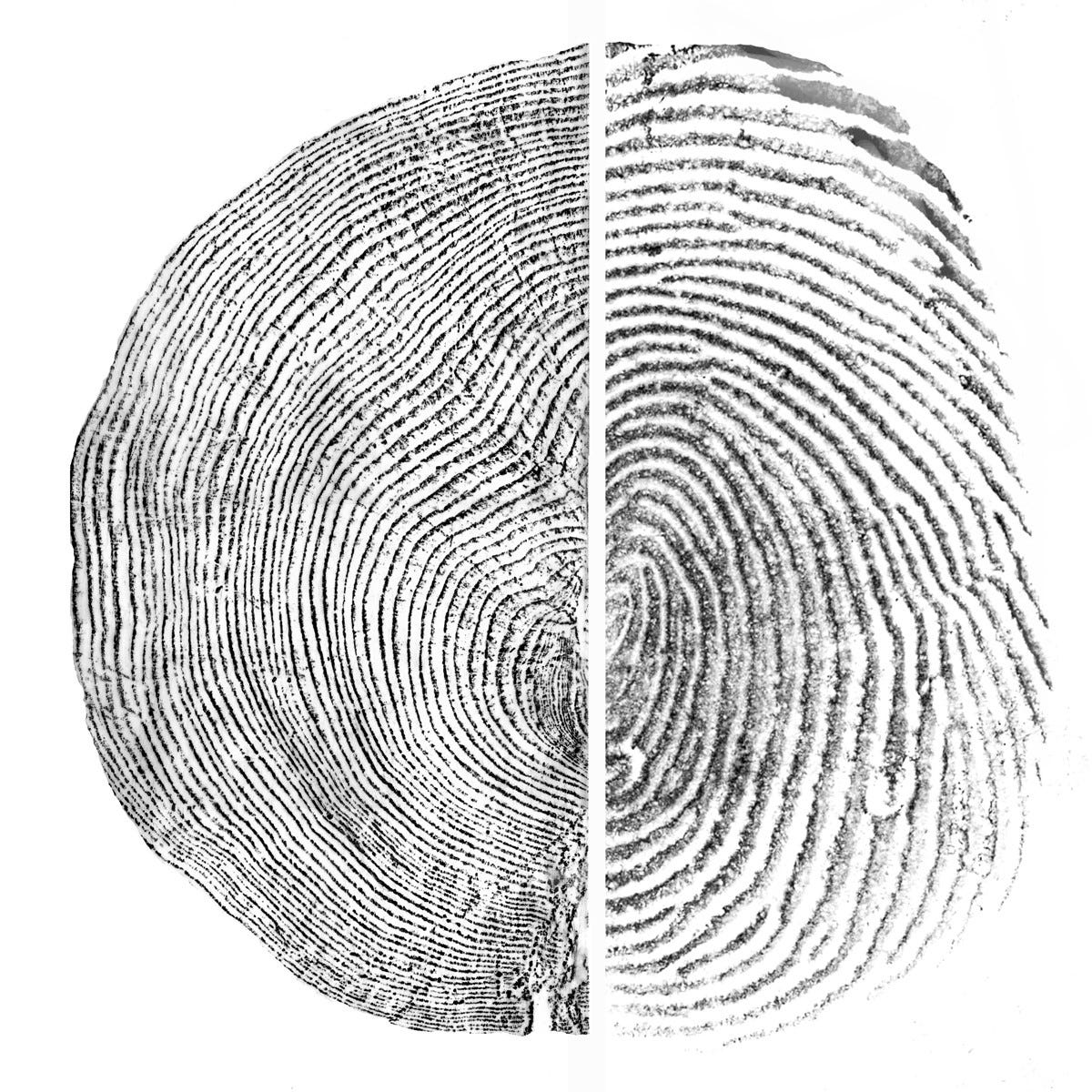
Image credit: Nina Montenegro
🎧 Prefer listening? Open the link in the Substack app and tap Play, or paste it into e.g. Paper2Audio (a free text-to-speech player) to turn it into an audio version
The 13th learning session of the Co-creation with the More-than-Human sandbox in May 2026 explored Catalysing Nature-Centrism with Matt Pritchard, Research Fellow at the University of Reading, and Marzia Briel, a Qualified Lawyer and Lecturer also at the University of Reading, both core team members of the Nature-Centric Catalyst project — a cross-disciplinary initiative funded by the V. Kann Rasmussen Foundation that aims to radically transform how we govern, in order to urgently reverse nature decline.
The session examined what a genuine shift from human exceptionalism toward deep care and reverence for nature actually requires — the evidence for what builds that shift in people, what governance approaches are gaining traction, and what remains stubbornly hard.
What follows is a synthesis of key questions, insights, and cross-cutting threads from the dialogue.
🌿 Learning Session 13 (May 2026) — Synthesis
Catalysing Nature-Centrism, with Matt Pritchard and Marzia Briel (Nature-Centric Catalyst, University of Reading)
What if transforming how we govern nature isn't primarily a technical challenge — but a cultural one, rooted in how deeply we care for and connect with the living world?
1. Why are we still heading in the wrong direction — and what does the Catalyst do about it?
The great dying, and a crowded toolkit that isn’t working
Species are going extinct at an alarming rate. But what the data also shows — and what is less often named — is the quieter, slower emptying out of populations. What some now call the great dying. The most recent Living Planet Index found an average decline of 73% in monitored vertebrate populations since 1970 alone.
This has happened against a backdrop of international agreements, ESG frameworks, biodiversity net gain requirements, nature finance initiatives, and an expanding data infrastructure. The tools have multiplied. The trajectory has not significantly changed.
The strongest lever is shifting the paradigm
The Catalyst draws on an insight from Donella Meadows‘ systems theory: the interventions we reach for first — economic incentives, measurement frameworks, technological fixes — are, by definition, the weakest levers for systemic transformation. The strongest lever is the paradigm. The mindset that shapes what decisions are even thinkable.
The paradigm that has governed environmental policy is still fundamentally human-centric: nature has value because it serves human needs. And when nature’s interests conflict with human interests, human interests tend to win. The Catalyst’s premise is that two things need to shift: seeing ourselves as part of nature rather than separate from it, and ascribing inherent value to more-than-human life — not merely instrumental value.
These are not new ideas. The Intergovernmental Science-Policy Platform on Biodiversity and Ecosystem Services (IPBES), the UN, and the European Environment Agency have all converged on this conclusion in recent years. The question is how that shift actually happens — in people, and in the institutions they inhabit.
🌱 Seed:
The ecological crisis is not primarily a knowledge gap or a tools gap. It is a paradigm gap. And paradigm shifts happen not through more data, but through a different quality of relationship with what the data is about.
2. Two pathways: nature connectedness and governance
Why these two — and why together?
The Catalyst is working along two parallel pathways, which it sees as inseparable.
The first is nature connectedness — the extent to which an individual genuinely feels themselves to be part of nature, in a way that is bound up with their identity, not just their stated values.
The second is governance — the structural mechanisms through which nature can be given a voice in the decisions that affect it. Rights of Nature (e.g. rights of rivers), Nature as governance stakeholder (e.g. ocean trusteeship, Nature on the Board) and Nature representation (e.g. multispecies assemblies): they provide different answers to the question of how to represent non-human interests within human institutions.
The thesis is that neither pathway works without the other.
Better governance frameworks, introduced into institutions populated by people who still hold fundamentally human-centric worldviews, tend to get hollowed out or instrumentalized. Deeper nature connectedness in individuals, without structural change in the institutions they work within, remains personal and peripheral. The Catalyst is working both levers at once.
🌱 Seed: A governance framework without the inner shift it assumes is a container without content. An inner shift without structural change is a conviction without consequence. The Catalyst is trying to build both.
3. What actually shifts people’s relationship to nature?
The single intervention problem
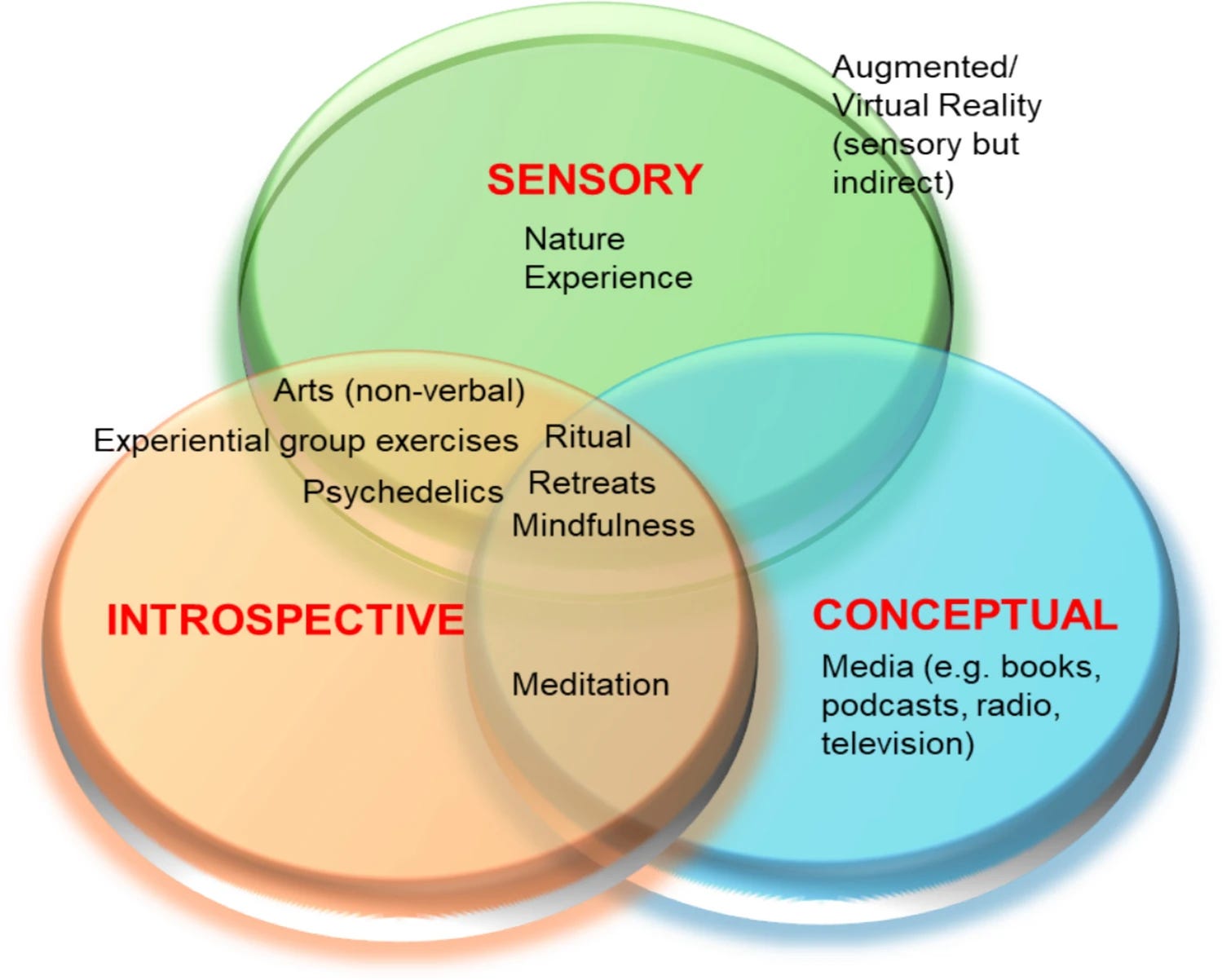
There is now a substantial body of research on nature connectedness and the interventions that build it: time in wild landscapes, nature-based meditation, arts practices, virtual reality experiences, even psychedelics. Each has been studied. Each produces real effects.
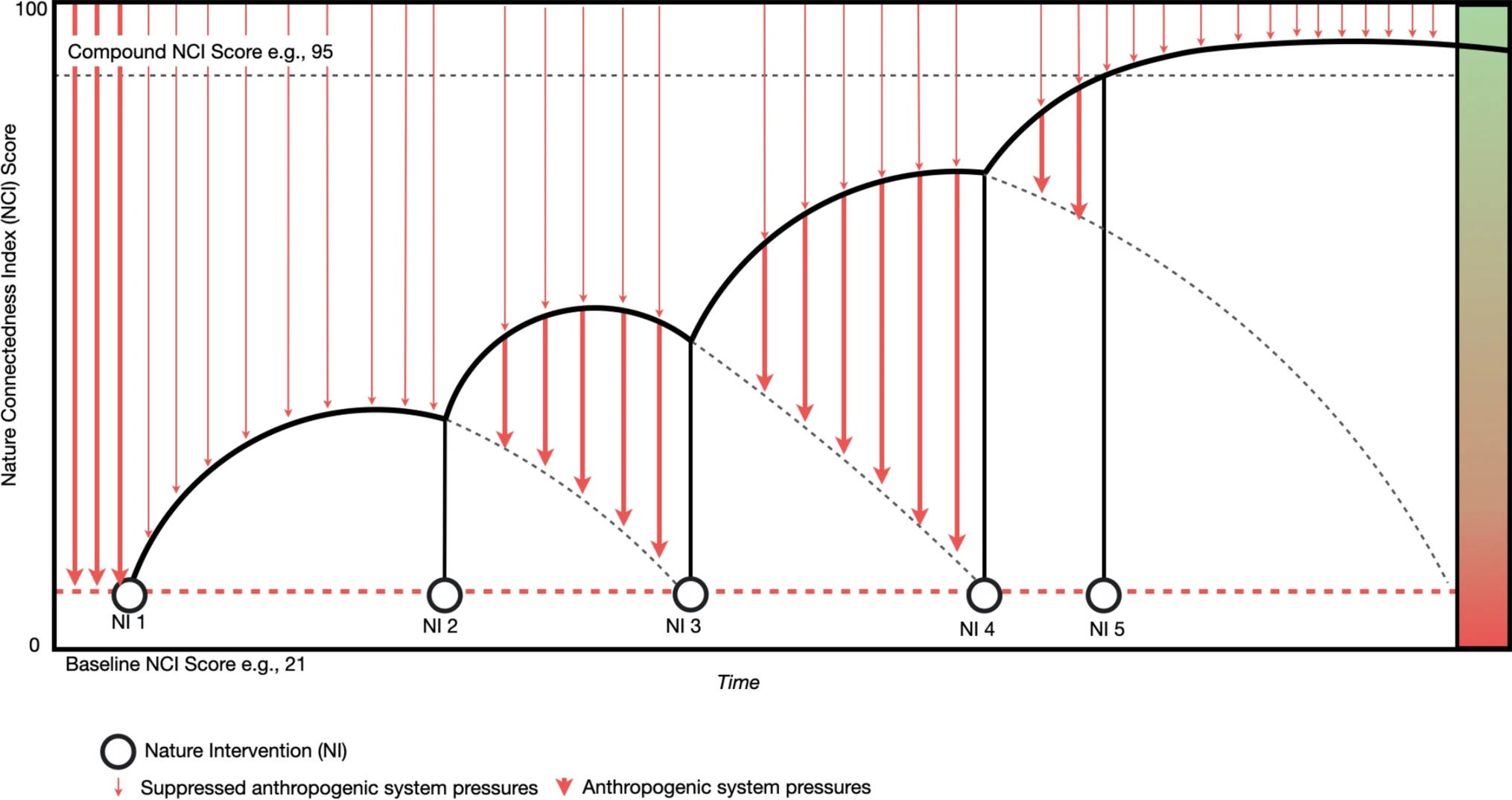
But the pattern that really matters is this: over time, the impact tends to wear off. People return to their previous disconnected state. The question the Catalyst set out to investigate was what creates compounding, lasting effects — what happens when you combine different types of intervention, in sequence and at pace, so that the impact does not dip back down between experiences.
The extinction of experience
One finding from the literature review stands out for its systemic importance: a strong predictor of high nature connectedness in adults is consistent nature exposure in childhood. What some researchers now call the extinction of experience — the progressive loss of everyday contact with the living world as cities expand — means that children grow up with less access to the very experiences that build the relational foundation for caring about nature as adults. This is a vicious circle that operates quietly, over generations, beneath the level of most policy conversation.
The Ambio paper: compounding interventions
The Catalyst has published an article in the journal Ambio titled Catalysing Change Through Compound Nature Connectedness Interventions. It reviews the many experiments on different kinds of intervention that can boost nature connectedness - such as time spent in wild places, nature-related arts, technological representations of nature, meditation, mindfulness and even psychedelic substances - and explores the conditions under which interventions compound. The central finding is that combining different interventions and reinforcing them, rather than them being merely occasional, produces significantly more durable shifts in how people relate to nature. The Catalyst has developed a diagram to represent this, which underpins much of the rest of the project’s design logic.
A multifaceted experience
The coffee house format the Catalyst has developed is a direct embodiment of the compounding interventions research, drawing on the 17th-century coffee house tradition in which people from very different backgrounds gathered to think together. (Those original coffee houses — sometimes called “penny universities” — counted Isaac Newton among their regulars.) Not a conventional academic workshop, but a day that moves through knowledge exchange, into emotional and artistic encounter, into informal conversation across sector and seniority, inviting people to step out of their institutional roles and come as their whole selves.
The theory: if someone leaves having both understood something new and felt something, the effects are more likely to compound than if only one register was activated.
Slow ecology
The coffee house also follows what the Catalyst describes as slow ecology principles. It creates unhurried conditions for conversations that faster formats foreclose — the kind of exchange that doesn’t happen in a plenary, but does happen over a drink between a senior policy-maker and a grassroots practitioner who has never been in the same room before.
The ripple effects from these events are hard to trace precisely, but they are real. Two people connecting, something catalyzing, travelling back into the institutions they inhabit in directions that could not have been planned. This is consistent with what the compounding interventions research suggests: that the most significant shifts tend not to come from large-scale top-down programmes, but from people who have actually experienced something different.
🌱 Seed:
Single experiences fade. What lasts is the compounding of different kinds of encounter — emotional, social, embodied, intellectual — over time. The format of how you convene people is itself a theory of change.
4. Immersive technologies — uses, abuses, and limits
A more honest answer than most
One strand of the Catalyst’s research examined immersive technologies — augmented reality, virtual reality, computer gaming, human augmentation — as potential pathways to nature connectedness. The headline finding is that exposure to real nature is almost always more effective for building nature connectedness than virtual versions.
But that is not the end of the story. Digital technologies can still play a meaningful role, particularly for those who cannot access real nature — and what matters enormously is how they are designed.
What makes technology work for connection
Formats that evoke awe, surprise, and fascination — especially for young people — are more likely to build genuine connection. First-person perspectives, in which users inhabit the viewpoint of another species, appear particularly promising. Augmented reality that allows people to compare what a landscape currently looks like against what it might become — better or worse — can make ecological stakes visceral in a way that abstract statistics cannot.
What makes technology work against connection
Familiar digital mechanics — notifications, competing features, advertising, engagement loops designed to maximize time on screen — may actively undermine the very connection they claim to support. The question to ask of any technology claiming to build nature connectedness is: what else is it optimizing for?
🌱 Seed:
The medium is not neutral. A technology that builds genuine nature connectedness is designed to be porous to the world it represents — not to capture the user’s attention for its own sake.
5. Governance approaches — how to catalyse them
The Catalyst has developed a four-step approach to catalysing nature-centric governance: de-risking, visioning, adapting, and scaling. Each addresses a distinct barrier to adoption.
De-risking: understanding what gets in the way
The first step, as the Catalyst has approached it, was a cross-sector workshop they called Mainstreaming Nature-Centric Governance: Risks, Barriers and Opportunities. Mirroring a systems approach, participants were drawn from economics, technology, law, activism, and national and local government — a range wide enough to surface different kinds of resistance and concern.
The logic is direct: if you can identify the risks clearly, you can also develop mitigations. That turns a vague set of objections into a more robust argument for adoption — and it allows the Catalyst to share its findings as a public catalogue, so that others working in this space don’t have to reinvent the wheel. The workshop also achieved something less tangible but equally valuable: cross-sector awareness and the beginning of a community of practice among people who would not normally encounter each other’s work.
That work has since fed into an effectiveness framework the Catalyst is currently finalising — a tool that will allow others to assess which governance approach could be most effectively applied in their specific context, whether that is a local project, an organisational decision-making process, or national government policy.
Rights of Nature: the most developed track record
Of the various governance approaches the Catalyst is reviewing — including Rights of Nature, nature as governance stakeholder, such as Nature on the Board, and nature representation, such as multispecies assemblies — Rights of Nature has the longest history and the most accumulated evidence. Around the world, rivers, mountains, and ecosystems have been granted legal standing with varying degrees of practical effect. The direction of travel is broadly upward. There are setbacks. But there is also momentum.
Nature on the Board and multispecies assemblies: new and growing
Both are considerably newer, and the peer-reviewed evidence base is thin — not because the approaches don’t work, but because there hasn’t yet been time for the evidence to accumulate. What is clear is that both are attracting growing interest, and an increasing number of organizations are willing to experiment. The Catalyst is tracking this field in real time.
Adapting the approaches to context
One of the practical insights from the project is that governance approaches often need to be adapted rather than applied directly. An example from the Catalyst’s own work: rather than a conventional multispecies assembly, they expanded the list of stakeholders in a systemic risk assessment — funded by the UK’s Advanced Research and Invention Agency — to include future generations and nature itself. This allowed a risk assessment of novel environmental interventions (including transgenic species) to incorporate longer-term thinking and a pluralistic, multi-perspective analysis that standard frameworks exclude.
Scaling: creating enabling environments
In March 2026 the Catalyst convened two parallel workshops to explore what scaling actually requires. The first brought together 25 senior policymakers to explore how to create enabling environments for nature-centric governance approaches. The second brought together grassroots projects already working to give nature a voice in decision-making, helping them develop practical, deliverable plans for doing so more effectively.
The senior-level engagement confirmed that appetite for these approaches exists at that level: participants expressed willingness to champion them within their own organisations. The feedback also gave the Catalyst invaluable pointers on what scaling in government actually requires in practice — including the importance of simple language, tying proposals to deliverables government already has, and embedding nature-centric thinking into education.
🌱 Seed:
No governance approach works everywhere in its original form. De-risking, visioning, adapting, and scaling are not sequential stages — they inform each other. The work is to understand what each approach makes possible and then to find the form that makes it real in the specific context it enters.
6. Visioning: the housing crisis as a test case
Why visioning matters
De-risking establishes that an approach is defensible. But defensibility is not the same as desire. For nature-centric governance to gain real traction, people need to be able to see a different future — to feel, concretely, what it would mean to design places and systems in which nature is not managed alongside human life but understood as its foundation. That is what visioning does: it makes the third horizon imaginable, not just arguable.
The hardest imaginable test
The Catalyst applied its governance frameworks to one of the most politically charged policy challenges in the UK: the government’s commitment to building 1.5 million new homes. Where only 13% of UK rivers are in good ecological health, the potential impact on nature is acute — and the political pressure to prioritize housing is intense.
Three horizons
Using the Three Horizons framework, the project mapped the current situation: the first horizon is the existing legal status quo — the Environment Act, polluter pays principles, and enforcement gaps. The second horizon is enforcement: why aren’t we applying the laws we already have? The third is the genuinely nature-centric vision — designing places in which nature is not accommodated around housing, but is central to what housing is for.
A virtuous cycle
The exercise surfaced something important about the logic of visioning itself. If we can tap into communal norms — if enough people come to see themselves as part of nature rather than separate from it — then genuinely different solutions become thinkable. And once those solutions begin to be enacted, a virtuous cycle becomes possible: nature recovers, people’s relationship to it deepens, and the political conditions for further change improve. That cycle runs in both directions. The current trajectory is a vicious one: as people lose contact with nature, they care less; as they care less, political will erodes; as will erodes, nature declines further. Visioning is, among other things, a practice of interrupting that cycle.
The cascade argument
The exercise surfaced something important: nature-centric housing is not in competition with human wellbeing. It cascades into it. People’s mental health, their connection to place, their relationship to where they live — all of these are enhanced, not compromised, by genuinely nature-centric design. The competing interests framing turns out to be, in many cases, a false choice.
But holding that argument clearly when a planning committee is facing housing targets is a different matter. The gap between the third horizon and the first is enormous. And closing it requires more than good frameworks — it requires the people inside institutions to have a genuinely different relationship to what they are deciding about.
🌱 Seed:
Nature-centric governance is not a sacrifice of human interests. But making that visible — and making it wanted — requires more than argument. It requires people to have glimpsed the third horizon clearly enough to feel the pull of it.
7. Who can represent nature — and what does it actually take?
More than a procedural question
Rights of Nature requires a human to speak for the river. Multispecies assemblies require participants to genuinely inhabit the interests of a bird, an otter, a mycorrhizal network. Nature on the Board requires someone to ask, in a boardroom, what the non-human stakeholders in this decision actually need.
What makes this more than procedural is what it demands of the person doing the representing.
The participants who have most effectively inhabited non-human perspectives in the Catalyst’s workshops have tended to be people with a long, embodied relationship to a specific place or species — not those with the most ecological knowledge in the abstract. One practitioner spoke of going into schools and asking children to imagine being an otter in a river — feeling what it feels like, sensing what it needs — as a form of nature representation that no legal framework alone can replicate.
The shift this requires
The shift from human exceptionalism toward genuine nature-centrism is not primarily an argument that can be won. It is a capacity that has to be developed — through repeated encounter, through different kinds of experience, through the gradual realization, felt in the body, that the separation between self and living world is less absolute than the dominant culture has led most of us to believe.
🌱 Seed:
Representing nature is not a role that can be filled by conviction alone. It requires the relational capacity to actually feel what is at stake — and that capacity is built through time, encounter, and presence, not through appointment.
8. The fullness of nature — holding what we find hardest to love
Not only beautiful
Nature is not only beautiful and generative. It is also indifferent, sometimes violent, full of death, decay, parasitism, and competition. A governance framework that only relates to the version of nature we find easiest to love — the wildflower meadow, the songbird, the chalk stream — is not truly nature-centric.
Meeting people where they are
This also has practical implications for how nature connectedness is built. Nature connection is not a single experience — it is a range. For some people it is smelling the flowers; for others it is hardcore mountaineering or two weeks in the wilderness barely eating. The entry point matters less than the direction of travel — and the willingness to encounter nature in its fullness, including its difficulty.
Fear of nature as data
The fear of nature — the impulse to poison, drain, or eliminate — is not irrational. It is a response to real experiences of danger, disgust, and loss of control. A nature-centric framework that ignores or dismisses that fear will not reach the people who most need reaching. Meeting people where they are means acknowledging the fear, not bypassing it.
🌱 Seed:
The version of nature we find easiest to care about is not the only version that needs governance. The work of building genuine nature-centrism has to hold the difficult parts of the relationship alongside the beautiful ones.
9. Can institutions actually want this?
The gap between what institutions say and what they do
One of the harder questions in the dialogue is whether existing institutions are capable of genuinely wanting nature-centrism, not just endorsing it rhetorically. Rights of Nature declarations have been passed, and rivers have continued to be polluted. Biodiversity net gain requirements exist on paper while habitat loss continues. The gap between stated values and actual decisions, when interests conflict, is not closed by better frameworks alone.
Pockets, ripples, and time
The Catalyst’s response to this is neither naive optimism nor resignation. It is a particular kind of strategic patience: building demonstrated cases; putting nature-centric thinking into executive education and MBA programmes; bringing senior policy-makers and grassroots practitioners into the same unhurried space, so that something shifts in the room and travels back with people into the institutions they inhabit.
The most likely pathway to change, in this analysis, is not top-down mandate but the accumulation of pockets of people who have experienced something different — and who carry that experience with them, as a different kind of knowing, into the decisions they make.
🌱 Seed:
Institutions change when enough people inside them have had a different experience of what is possible. The work is to multiply those experiences — and to make them stick.
What comes next
Multispecies collective intelligence
Matt is turning his attention to multispecies collective intelligence — the question of what the diverse forms of intelligence present in the living world look like, and how human organizations might learn to blend human intelligence with those other forms in ways that are genuinely ethical and practically grounded. This includes, necessarily, the question of how AI sits alongside other forms of intelligence — a question whose implications are only beginning to become visible.
Into unconverted territory
Marzia is heading toward taking these ideas into organizations not yet persuaded — water companies, political actors, anyone currently on the nature-destruction path — and into executive education at Henley Business School. Alongside that, a more personal strand: nature meditation, and a more philosophical engagement with what nature connection actually means and demands.
Both trajectories share a direction: less toward those already convinced, more toward the places where the conversation has not yet happened — and where, when it does, it might actually change something.
Cross-cutting insight threads
Paradigm shift is the leverage point — but it’s the hardest to pull
The Catalyst explicitly locates its work at the strongest end of Meadows’ leverage points: shifting the mindsets and goals of the system. That is where real transformation happens. It is also where the resistance is greatest and the evidence base is thinnest. The project is trying to build that evidence — while doing the work at the same time.
Connectedness → governance: neither works without the other
Inner shift without structural change remains personal. Structural change without inner shift gets hollowed out. The Catalyst is one of the few projects attempting to develop both pathways simultaneously — and to understand how each enables the other.
The childhood thread
Nature connectedness in adulthood is strongly shaped by nature exposure in childhood. The extinction of experience — less wild, less varied, less freely accessible nature for children to grow up in — is a slow-moving crisis within the crisis. It rarely makes headlines, but it may be one of the most consequential drivers of the long-term trajectory.
Evidence-based, but not only evidence-based
The Catalyst is explicitly an evidence-gathering project. But the shift it is working toward — from human exceptionalism to genuine reverence for life — is not something people can be reasoned into. What the evidence reveals, repeatedly, is that the pathway runs through felt experience, not argument. That is a finding with significant implications for how institutions approach nature-related governance and education.
Reaching those not yet persuaded
Much of the work in this space — conferences, workshops, academic papers — reaches the already converted. The Catalyst is increasingly oriented toward taking these ideas into organizations currently on the nature-destruction path: water companies, decision-makers, business school students who have never been asked to consider what a river might need.
The Nature-Centric Catalyst’s annual report is publicly available. The paper “Catalysing Change Through Compound Nature Connectedness Interventions” is available as open access. Further publications — including an essay on nature-centric housing in the journal Planning Theory and a chapter in the forthcoming book Post-Digital Nature Connection (Springer, ed. Jack Reed, University of Exeter) — are in preparation.
Closing
These sessions are not designed to arrive at fixed answers, but to surface how different approaches work in practice. Each conversation reveals not only how and where they hold, but also the tensions and questions that remain unresolved—and that continue to invite further inquiry.
Over time, these syntheses form a growing body of insights into what co-creation with the more-than-human world might require, across contexts and practices.
The Co-creation with the More-than-Human sandbox is a collaboration between The Repatterning Collective and Kincentric Leadership.
If you’d like to receive announcements of our popular monthly online learning sessions, which use live dialogue & discussion to explore different approaches and praxes for meaningful co-creation with the more-than-human (natural) world, then register here for the sandbox’s mailing list.
To receive syntheses of Learning Sessions and Field Dialogues in your inbox, subscribe below.
We donate our time and energy to this sandbox. If you value this space, consider co-funding this work by leaving us a tip.